Live, mentor-led lessons
Every lesson happens in real time with a mentor — never a prerecorded video.
Full details for this course are arranged during your consultation — request one and we will walk you through it.
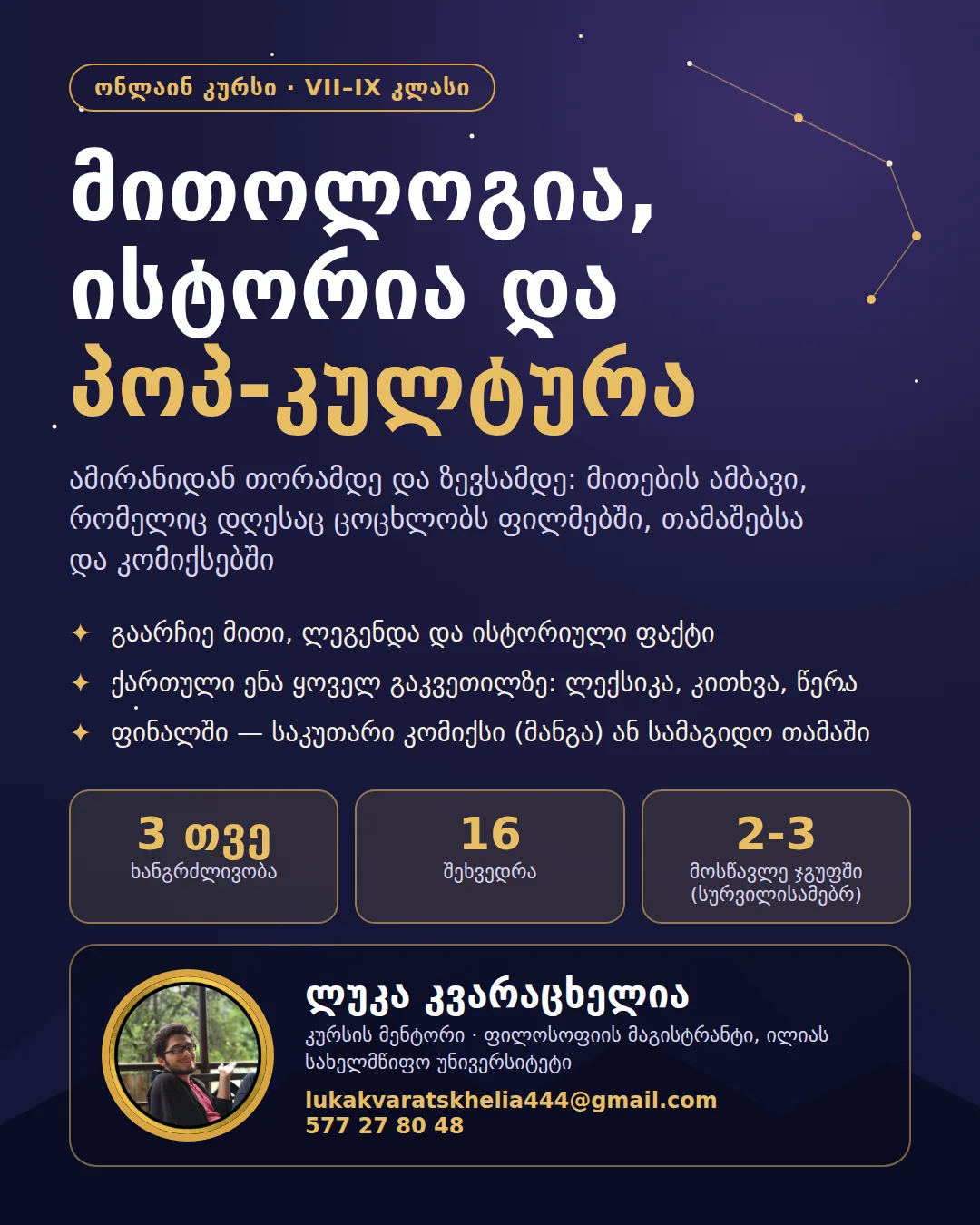
The course is designed for Georgian children in grades VII–IX who live in the diaspora. Its aim is to show where the gods and heroes of films, comics and games come from, and to strengthen the learners' living connection with the Georgian language and cultural memory. Students get to know Scandinavian, Greek-Roman, Eastern and, above all, Georgian mythology, from Amiran to the Golden Fleece of Colchis. The course is taught online in a small group of up to 12 students, through video meetings and a shared Padlet space. Every lesson includes a Georgian Language Corner of about 10 minutes: 5–7 new words, a short Georgian text and a short writing task at two difficulty levels. By the end, students can tell a myth, a legend and a historical fact apart, read a source critically, and present their own comic (manga) or board game together with a Padlet portfolio.
Myth, Legend or History? Creation Myths
Language focus: thematic vocabulary (myth, tradition, deity, beginning, legend, source); reading a short folk text about the creation of the world; one sentence in Georgian about oneself and one sentence about the text. Activity: an ice breaker and visual introduction, where students place a pin on the Padlet map (where they live and which part of Georgia their family comes from). Then they sort 5–6 short stories (Amiran, Kartlos, the year 337, 9 April) into three columns — myth, legend, historical fact — and justify their choice. Lessons 1–2: Course introduction, rules and Padlet: who we are and where we are from; Myth, legend or historical fact?
The Scandinavian Pantheon: Myth, Source and Pop-Culture Versions
Language focus: vocabulary (pantheon, epic, record, manuscript, interpretation); a written task of 3–4 sentences on how a character familiar to the student differs from the original myth. Activity: comparing the mythological and pop-culture versions of the Scandinavian gods (guess which image belongs to which interpretation). On a Padlet Timeline students build a path — oral tradition, written record, comic, film — and discuss why a source must be read critically. Lessons 3–4: Thor, Odin and Loki: from myth to pop culture; Who wrote down the myth, and when?
Georgian Mythology and History: From Pantheon to State; Creating a Character
Language focus: vocabulary (paganism, Christianity, idol, tradition, holiday, king); reading an adapted version of Amiran; describing one's own character in 2–3 sentences in Georgian. Activity: getting to know the Georgian idols (Armazi, Zaden, Gatsi and Gaim), King Parnavaz and the adoption of Christianity (in 337); comparing the myths of Amiran and Prometheus. Practical task: each student creates their own mythological character with an origin story and publishes it on the Padlet Wall. Lessons 5–6: From Armazi to Amiran: the Georgian pantheon and the Kingdom of Kartli; My mythological character
Greek and Roman Myths; Colchis and the Golden Fleece
Language focus: vocabulary (ancient, colony, expedition, fleece, Colchian); a written task of 5–7 sentences: how a Greek traveller would see Colchis and how a Colchian would see a Greek. Activity: similarities and differences between Greek and Roman deities (Zeus and Jupiter). The myth of the Argonauts: sorting into three columns on a Padlet Shelf (myth / historical record / assumption) with justification; the game "Change the Character" (adapting Roman traits to a Greek character). Lessons 7–8: From Zeus to Jupiter: Greek and Roman myths; The Golden Fleece: myth or history?
Creating a Myth in a Historical Setting
Language focus: the structure and climax of a myth; fairy-tale and epic phrases ("Once upon a time, there was and there was not...") and a mythic tone; a writing workshop: two pieces of advice and one language correction for each text. Activity: students return to their own character and give it a historical background (era, place, conflict). In breakout rooms they write a mythological episode in which the characters take part together, publish it on Padlet and give each other peer feedback. Lessons 9–10: How does a myth preserve real events?; Myth-creation workshop
Eastern Myths; Eastern and Western Pop Culture; Georgia as a Crossroads
Language focus: vocabulary (merchant, caravan, crossroads, influence, tradition); a written task: a merchant tells news in a Georgian village — what myth would he tell? (one paragraph in Georgian). Activity: Japanese and Chinese mythology and its pop-culture interpretations (manga, anime); a discussion of the differences between Eastern and Western versions. On the Padlet map students mark trade routes (branches of the Silk Road) and place mythological stories on them with pins. Lessons 11–12: Myths from the East: Japan and China; Georgia at the crossroads: how stories travel
How to Create a Comic (Manga) or a Board Game with a Historical Context
Language focus: vocabulary (script, episode, rules, character, frame); writing the text of comic speech bubbles or the rules of a game in Georgian. Activity: students choose one of two options: manga (by hand or digitally, finished pages are uploaded to Padlet) or a board game (mechanics based on the map, trade routes and resources; prototype on Padlet Canvas). In breakout rooms they write a project plan: which myth, which historical background, who does what. Lessons 13–14: Manga or board game: choosing a project; Project plan, work and feedback
Presenting the Work; Bringing Myth and History Together
Language focus: a written task (3–4 sentences in Georgian): why knowledge of mythology and history matters and what has changed in my mind during the course; the Georgian text of the final project. Activity: presenting the projects (individually or in groups) — the mythological element, the historical background, the Georgian text; self-assessment with a rubric and peer feedback ("one thing I liked and one question"). Optionally, an online exhibition on Padlet with parents and other students invited. Lessons 15–16: Project presentation and assessment; Summary and exhibition
Every lesson happens in real time with a mentor — never a prerecorded video.
Your mentor follows your progress and responds to how you actually learn.
Progress is tracked as you go, so you always know where you stand.
Schedules are agreed in advance and shown in Tbilisi time, wherever you are.
Georgian children and teenagers living abroad who understand basic Georgian but want to speak it more confidently. The course suits learners who grow up between two cultures and want to express their thoughts, emotions and opinions in Georgian, while building practical life skills: critical thinking about online information, digital safety, and resolving conflicts peacefully. Lessons are held online in small groups, 35–40 minutes once a week.
We will confirm the right level, group and schedule for you.
Mythology, History and Pop Culture
Course information
An online course for children and teenagers living abroad who need to strengthen their spoken Georgian and build practical life skills. Students learn to express their opinions freely in Georgian, reason and argue on practical topics such as cultural diversity, media literacy and everyday ethics. Lessons are interactive and built on discussions, audio-visual materials and real-life cases. By the end of the course, students will be able to describe their emotions and dual cultural experience in Georgian, critically evaluate information spread on social media and the internet (spotting fakes), and communicate peacefully in Georgian in everyday relationships and conflict situations.
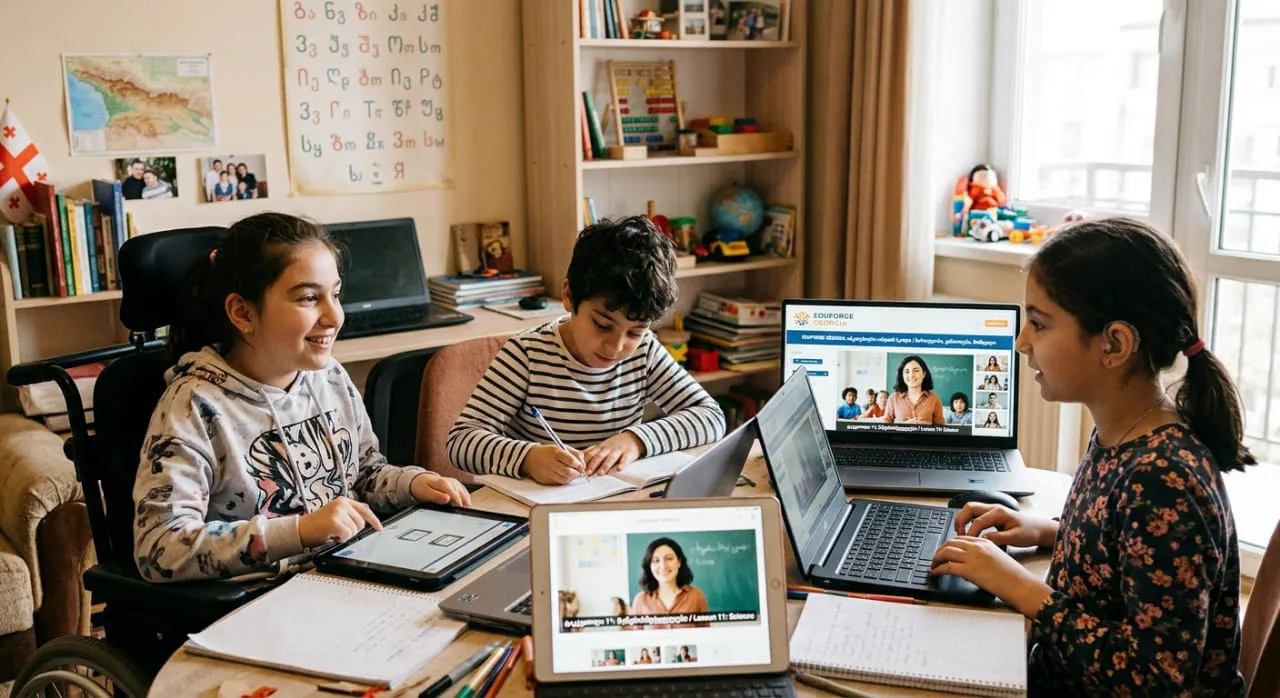
The program is intended for students with special educational needs (SEN) and with academic, behavioral, ADHD-related and emotional difficulties. It is delivered through online distance learning, individually or in small groups, within an individual education plan (IEP) or an adapted program. The main aim is to support the students' academic, cognitive, speech, behavioral, attention-regulation and emotional skills, to maximize their engagement in learning and to help them realize their individual potential. Teaching relies on adapted online strategies such as large clear fonts, visual schedules, short learning blocks, movement breaks, visual timers and positive reinforcement. The 16-week program (semester-based or continuous support) involves parents throughout and ends with an assessment of progress, a portfolio presentation and recommendations for the future.
"Children's Cooking" is a practical culinary course for children and teenagers who want to learn the basics of cooking, prepare simple dishes and develop practical skills. The course aims to teach the main rules of working in the kitchen, introduce ingredients and basic culinary techniques, and build independence, creative thinking and teamwork. Lessons follow the principle "I see — I learn — I do it myself": the mentor, chef Luka Darsalia, first demonstrates a technique, and then the children complete the task step by step, taking their age and experience into account. Work with hot surfaces, the oven, boiling water and sharp tools is always done under direct supervision. Over 12 weeks the children get to know the cuisines of different countries and prepare breakfast, salads, pasta, pizza, a burger, an Asian bowl, desserts and a Georgian dish. By the end of the course, students can follow hygiene and safety rules, read a recipe, help prepare simple dishes, decorate and present their own dish, and work as part of a team. No previous experience is required.