Live, mentor-led lessons
Every lesson happens in real time with a mentor — never a prerecorded video.
Full details for this course are arranged during your consultation — request one and we will walk you through it.
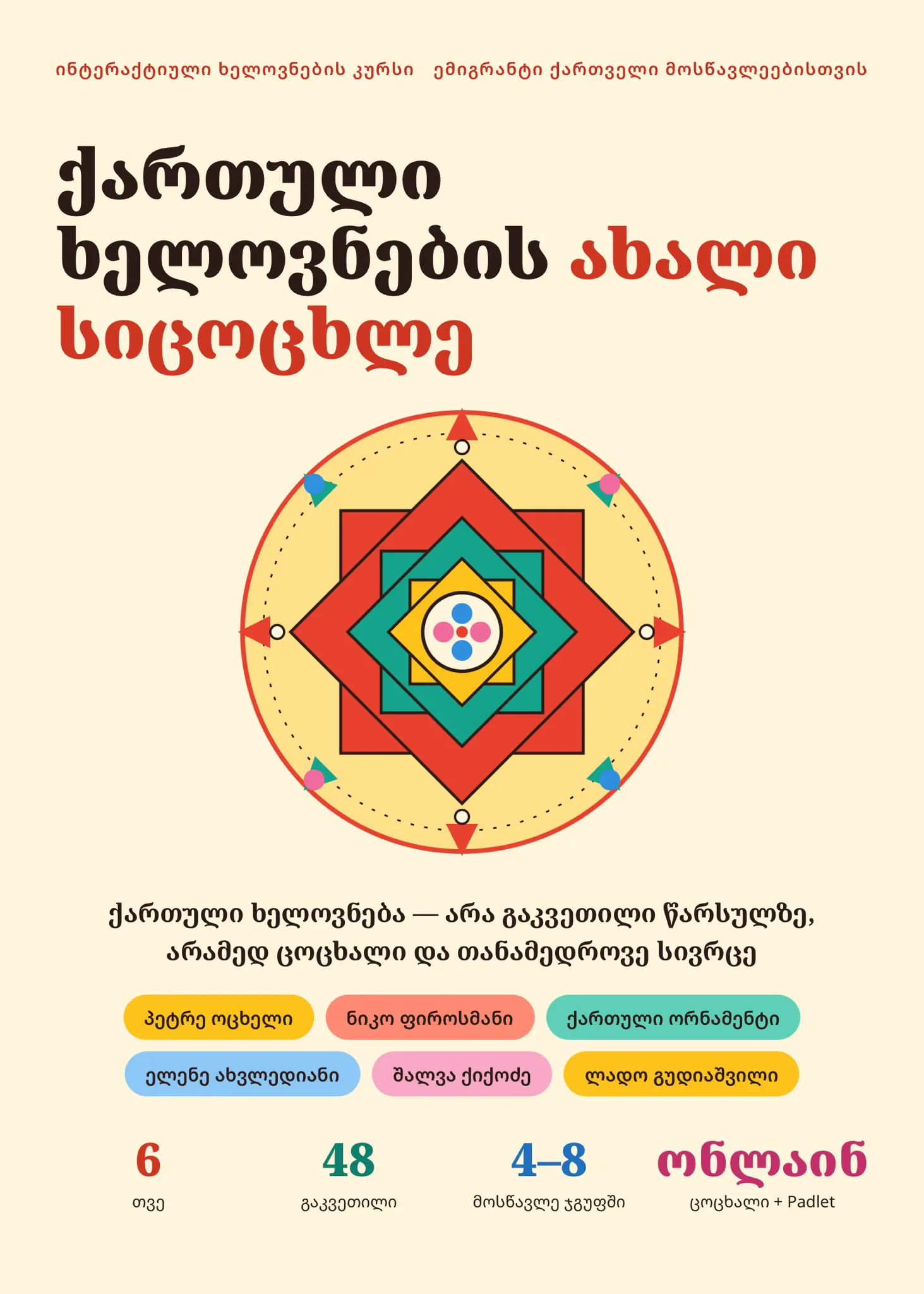
The course is designed for emigrant Georgian children who grow up between two cultures and whose connection to Georgian often weakens in everyday life. Its aim is to turn Georgian cultural heritage from a "lesson about the past" into a living, contemporary and interesting space, and to deepen the connection between the children and Georgian language, art and identity. Lessons are held online: live sessions are combined with a digital workspace on Padlet and four short video instructions (Padlet, Canva, audio stories, simple animation). The teaching follows project-based learning (PBL) and STEAM, so students act as researchers and creators, and every module ends with a final product and a short presentation. Over 6 months (48 lessons of 60 minutes, two per week) the children get to know five Georgian artists and Georgian ornament, and in every lesson they speak Georgian, learn topical vocabulary and write short texts. As a result they gain real practice in speaking and writing Georgian, knowledge of Georgian art, digital skills and creative confidence, and they finish each module with a ready project, shown at two festivals with parents and certificates.
Petre Otskheli: Character Design
Weeks 1–4 (lessons 1–8). Students introduce themselves in Georgian, draw "My Two Worlds" (Georgia and the country where they live) and make their first Padlet post. They study the biography, costumes and sketches of the artist and stage designer Petre Otskheli, learn his geometric, monumental style, and take on the main challenge of turning the "Flying Painter" into a superhero or character. They invent the character's name, personality, superpower and short backstory in Georgian, work on 2–3 sketches, silhouette, costume influenced by Georgian ornament, and a colour palette they justify ("Why did I choose these colors?"). They learn to give constructive feedback in Georgian ("I like that…", "something could be added…") and revise their work. Final product: an original superhero or antagonist character and the virtual exhibition "Comic-Con Georgia", to which parents may be invited as observers.
Niko Pirosmani: Narrative and Space
Weeks 5–8 (lessons 9–16). Students learn about Niko Pirosmani's life and the essence of naive art, look at famous works and discuss in Georgian what they see, what the characters feel and why Pirosmani loves simple forms. They try his black-oilcloth technique (black background, coloured accents) by painting "My Family's Table" or "My Street". They then imagine what lies beyond the frame, gather material and build a digital or physical collage extending the setting, recalling the Canva video instruction (removing backgrounds, PNG layers). They write a short story about their painting's character in Georgian (beginning, complication, ending), record an audio narrative or short "podcast" working on pronunciation, pace and intonation, and upload everything to a shared Padlet gallery, leaving comments. Final product: a Pirosmani-style painting, its extended space and an audio story in Padlet's interactive museum, where students give each other "tours" in Georgian.
Georgian Ornament: Branding
Weeks 9–12 (lessons 17–24). Students explore Georgian ornaments in carpets, stone carvings and clothing, discuss the meaning of symbols and collect vocabulary in Georgian (circle, cross, spiral, symmetry and more). They look for ornaments in family belongings, books and photos and sketch them, learning to see an ornament "through a scientist's eyes". They break an ornament down into simple geometric shapes (circle, triangle, square) and build a new original pattern using repetition, symmetry and a colour palette. They observe how brands use cultural symbols (clothing, skateboards, printed products), choose what to make (logo, skateboard, T-shirt or another item), and design it in Canva (Figma too, depending on age), adding a brand name and a short slogan in Georgian. They write and rehearse a short presentation (what my brand is, which ornament it is based on, who it is for) and give each other peer feedback. Final product: their own brand inspired by Georgian ornament and a modern merch design (logo, skateboard or clothing), presented in a virtual Pop-Up Store.
Elene Akhvlediani: Fairy-tale City
Weeks 13–16 (lessons 25–32). Students learn about the life and stage-design works of Elene Akhvlediani, look at tilted houses, balconies, courtyards and the theatrical mood, and describe in Georgian what they see and how the city seems to them. They sketch their own fairy-tale Tbilisi (houses, balconies, streets, characters), working on perspective and simplifying forms. They learn the stage-design principle of foreground, middle ground and background, divide the sketch into layers and build a 3D / pop-up composition from cardboard (or digitally in Canva), creating depth. They add winter details, lighting and colour atmosphere, and, following a video instruction, simple animation (snow, twinkling windows) in CapCut or Genially. They prepare an invitation for parents on Padlet, write a short speech about their work and rehearse the presentation. Final product: a layered (3D / pop-up) fairy-tale Tbilisi composition and a mid-course New Year festival with parents, where each student presents in Georgian, reflects ("What did I learn?") and receives an interim certificate.
Shalva Kikodze: Between Two Cities
Weeks 17–20 (lessons 33–40). Students meet the Georgian modernist painter Shalva Kikodze, who worked in Paris, look at his works and discuss in Georgian what life is like in a country that is not your home, linking their own emigrant experience to the artist's story. They learn how line, shape and proportion build a portrait, draw quick on-screen portraits of each other in pairs and describe facial features in Georgian. They study how Kikodze conveys emotion through colour and line, collect emotion vocabulary ("homesick", "happy", "confused") and paint a colour sketch "My Mood Today". They create a self-portrait "Between Two Cities" with Georgia on one side and the city where they live on the other, working on composition, colour pairs, background and the final palette. They ask a grandparent or another relative three questions in Georgian (for example, "What do you love about Georgia?") and paint their portrait from a photo or video call, then record a short audio letter, working on pronunciation and intonation. Final product: the portrait "Between Two Cities" (Tbilisi and the child's current city), a family member's portrait and an audio letter in a Padlet gallery.
Lado Gudiashvili: Color, Fresco, Fantasy
Weeks 21–24 (lessons 41–48). Students learn about Lado Gudiashvili's life, the Tbilisi bohemia and his colourful, fantastical world, comparing him with Petre Otskheli and Shalva Kikodze (what they share and how they differ). They look at Georgian frescoes and icons (flat forms, strong contours, golden accents) and draw a figure in fresco style. They create fantastical characters (musicians, animals, dancers), write a short description in Georgian and sketch them. They choose a family celebration or tradition (a feast, a wedding, New Year), plan the scene's composition, work on colour contrast, golden accents and repetition, and paint it in large format (A3 or digitally), adding ornament from Module 3. They curate the final exhibition: choosing the best works from all modules, writing short labels in Georgian about the artists and their own projects and assembling the show on Padlet. Final product: a fantastical Georgian celebration painting in large format, inspired by fresco and Gudiashvili's colourful world, and the final exhibition and festival, where parents attend, students present their six-month journey, reflect ("What did I learn?", "Which artist did I like and why?") and receive certificates.
Every lesson happens in real time with a mentor — never a prerecorded video.
Your mentor follows your progress and responds to how you actually learn.
Progress is tracked as you go, so you always know where you stand.
Schedules are agreed in advance and shown in Tbilisi time, wherever you are.
Georgian children and teenagers living abroad who understand basic Georgian but want to speak it more confidently. The course suits learners who grow up between two cultures and want to express their thoughts, emotions and opinions in Georgian, while building practical life skills: critical thinking about online information, digital safety, and resolving conflicts peacefully. Lessons are held online in small groups, 35–40 minutes once a week.
We will confirm the right level, group and schedule for you.
A New Life for Georgian Art – An Interactive Art Course for Emigrant Georgian Students
Course information
An online course for children and teenagers living abroad who need to strengthen their spoken Georgian and build practical life skills. Students learn to express their opinions freely in Georgian, reason and argue on practical topics such as cultural diversity, media literacy and everyday ethics. Lessons are interactive and built on discussions, audio-visual materials and real-life cases. By the end of the course, students will be able to describe their emotions and dual cultural experience in Georgian, critically evaluate information spread on social media and the internet (spotting fakes), and communicate peacefully in Georgian in everyday relationships and conflict situations.
The program is intended for students with special educational needs (SEN) and with academic, behavioral, ADHD-related and emotional difficulties. It is delivered through online distance learning, individually or in small groups, within an individual education plan (IEP) or an adapted program. The main aim is to support the students' academic, cognitive, speech, behavioral, attention-regulation and emotional skills, to maximize their engagement in learning and to help them realize their individual potential. Teaching relies on adapted online strategies such as large clear fonts, visual schedules, short learning blocks, movement breaks, visual timers and positive reinforcement. The 16-week program (semester-based or continuous support) involves parents throughout and ends with an assessment of progress, a portfolio presentation and recommendations for the future.
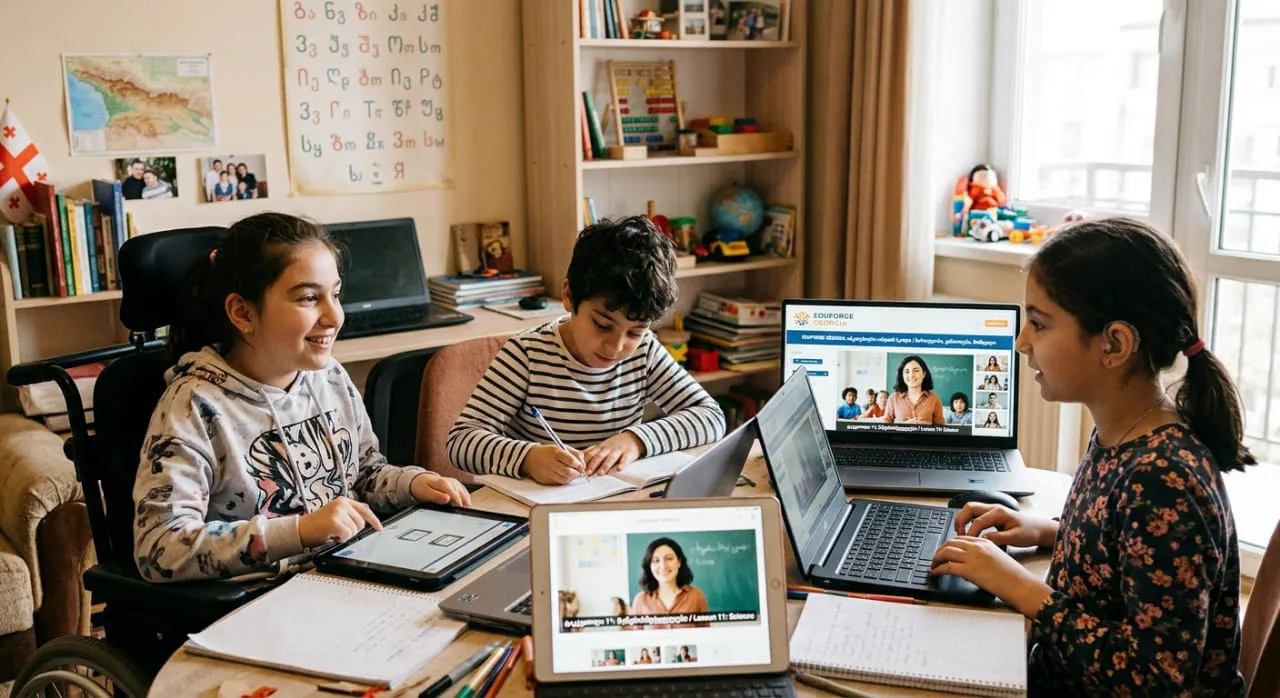
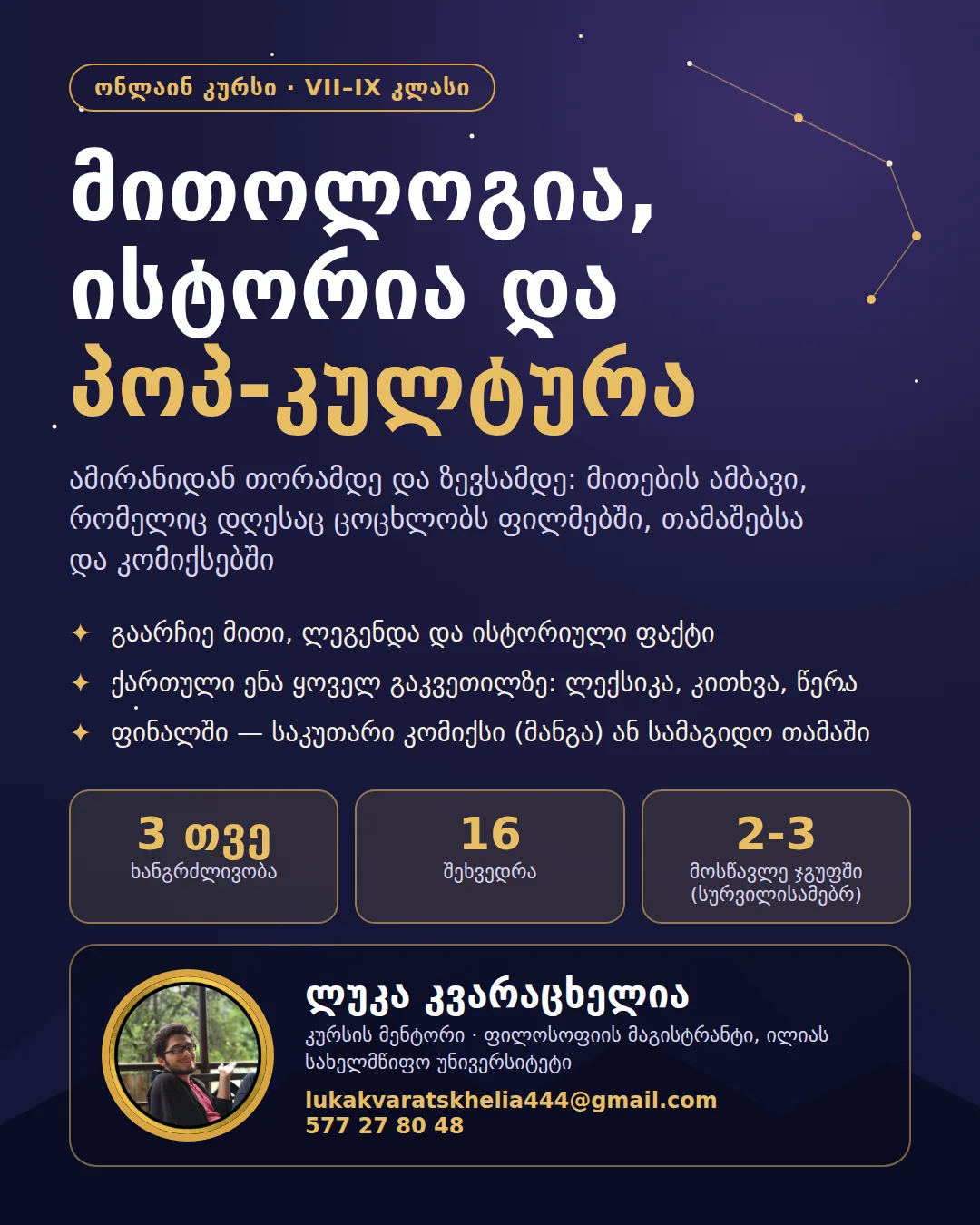
The course is designed for Georgian children in grades VII–IX who live in the diaspora. Its aim is to show where the gods and heroes of films, comics and games come from, and to strengthen the learners' living connection with the Georgian language and cultural memory. Students get to know Scandinavian, Greek-Roman, Eastern and, above all, Georgian mythology, from Amiran to the Golden Fleece of Colchis. The course is taught online in a small group of up to 12 students, through video meetings and a shared Padlet space. Every lesson includes a Georgian Language Corner of about 10 minutes: 5–7 new words, a short Georgian text and a short writing task at two difficulty levels. By the end, students can tell a myth, a legend and a historical fact apart, read a source critically, and present their own comic (manga) or board game together with a Padlet portfolio.